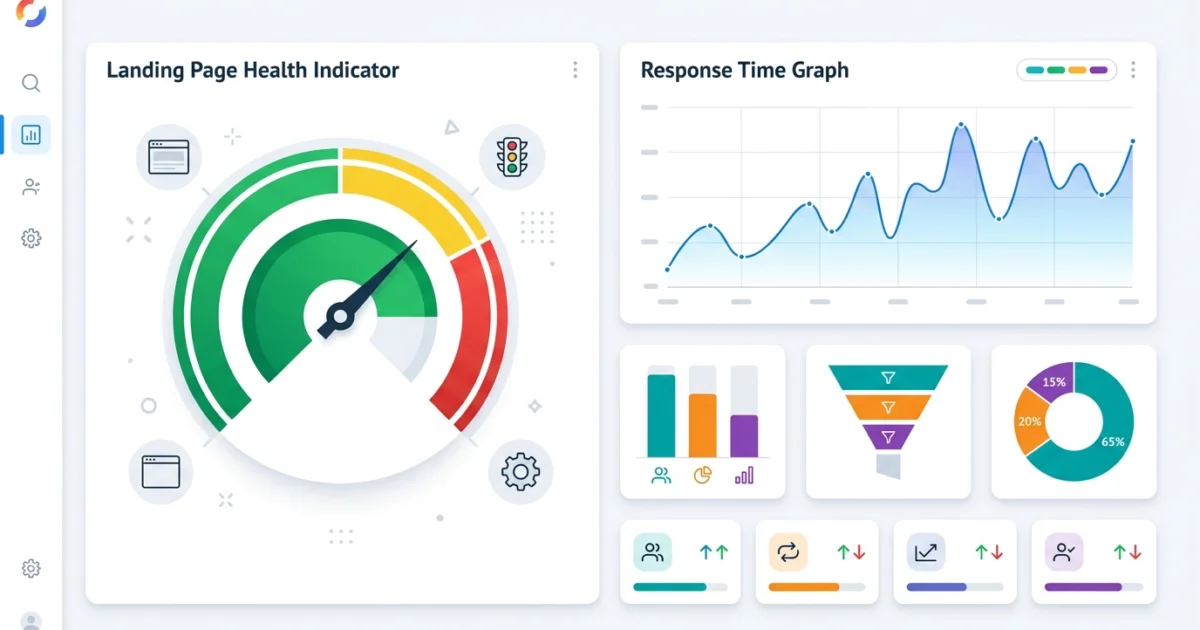
Most website monitoring tools were built for engineers who want to know a server is up. Marketing teams have a different, sharper problem: a campaign is live, money is flowing to a landing page by the minute, and if that page goes down — or just gets slow — the budget keeps spending while conversions quietly stop.
For a performance marketer, “is the site up?” isn’t an IT question. It’s a direct line to wasted ad spend and a campaign that underperforms for reasons that never show up in the post-mortem. The right monitoring tool flags those failures at its next check, so you can pause an ad group before the damage compounds.
This guide covers the best website monitoring tools for marketing teams in 2026 — what each does well, and which fits the job of protecting campaigns.
What marketing teams actually need from monitoring
Before the list, the criteria that matter when the thing you’re protecting is ad spend, not a server:
- Prompt, reliable down alerts — not a daily digest. Every minute a landing page is down during a live campaign is budget spent sending clicks to a dead page.
- Response time, not just up/down — a page that loads in eight seconds is technically “up” and still failing. Slow load times hurt conversion rates, and a slow landing page is a poor place to send paid traffic.
- Alerts that reach the right person — the media buyer who can pause the campaign, not just a developer’s inbox.
- Simple enough to own without engineering — marketers shouldn’t need a DevOps team to set up a landing page check.
UptimeRobot
UptimeRobot is the default starting point for good reason: a free tier, fast setup, and checks from multiple global locations. For a marketing team that just wants to know when a campaign URL goes down, it does the core job at no cost.
Best for: teams that want free, reliable up/down alerts on their campaign pages.
Worth knowing: it’s primarily an uptime tool. Response time tracking exists but isn’t the focus, and there’s no concept of tying monitoring to campaign workflows — it tells you a page is down, and the rest is on you.
Pingdom
Pingdom has long been popular with marketers because it pairs uptime monitoring with real page-speed and real-user monitoring (RUM) — the performance data that actually correlates with conversion rates and Core Web Vitals.
Best for: teams that care deeply about page performance and want detailed load-time analytics alongside uptime.
Worth knowing: that depth comes at a price. Pingdom’s synthetic and RUM products are priced as separate bundles, and the cost adds up quickly for a small marketing team monitoring a handful of landing pages. It’s a strong tool that’s often more than a lean team needs.
Better Stack
Better Stack brings fast checks and polished incident management. If your marketing org sits close to a technical team and you want downtime routed through proper on-call escalation, it’s excellent.
Best for: marketing teams embedded in a product org that already uses incident tooling.
Worth knowing: most of its value is in on-call and incident features built for engineers. A standalone performance-marketing team will pay for capabilities it won’t use, and the setup assumes more technical comfort than a typical media buyer wants.
Site24x7
Site24x7 monitors uptime, response time, and real user experience from a global network of locations, with deep analytics on how pages perform across geographies — genuinely useful if your campaigns run internationally.
Best for: larger marketing teams inside IT-heavy organizations that need global performance data.
Worth knowing: it’s an enterprise platform with the complexity and pricing to match. For a team whose job is “keep our campaign pages up and fast,” it’s a heavyweight solution aimed at a different buyer.
Kikloper
Kikloper approaches monitoring from the angle a marketing team actually works in: protecting the pages that paid traffic lands on. It checks landing page uptime and response time, and sends down alerts by email and push after a page fails two checks in a row (every 15 minutes on Pro, every 30 on Solo) — so a media buyer can pause the ad group before more budget burns. It also tracks SSL certificate expiry, which matters more to marketers than it sounds: an expired certificate shows visitors a “Not Secure” warning and can get ads disapproved mid-campaign.
Best for: performance marketers, PPC specialists, and small agencies who want campaign-focused monitoring without an enterprise platform — uptime, response time, SSL, and down alerts in one simple dashboard.
Worth knowing honestly: Kikloper currently checks from a single location rather than a global network, so if multi-region performance data across continents is central to your campaigns, a tool like Site24x7 or Pingdom will go deeper there. In exchange, Kikloper is simpler to own, flat-priced (Solo $4.99, Pro $9.99), and built around the exact failure that costs marketers money: a page going down or slow while the budget keeps spending. See how the alerting works on the down alerts page, or the marketing teams overview.
Why slow pages cost more than you think
It’s worth stressing the response-time point, because it’s the failure marketers most often miss. A landing page doesn’t have to go fully down to hurt a campaign. As load time climbs, conversion rates fall, so each paid click is less likely to turn into a sign-up. A slow page quietly makes every click worth less. Monitoring response time, not just uptime, is how you catch that before it shows up as a mysteriously underperforming campaign.
Who should pick what
- Start with UptimeRobot if you want free, reliable up/down alerts on your campaign pages and nothing more.
- Choose Pingdom if page-speed and real-user performance data are central to how you optimize, and you have the budget for it.
- Choose Better Stack if your marketing team sits inside a technical org that wants incident-grade alerting.
- Choose Site24x7 if you’re a large team running international campaigns and need global performance depth.
- Choose Kikloper if you want campaign-focused monitoring — landing page uptime, response time, SSL, and down alerts that tell you when to pause ad groups — in a simple, affordable tool built for the job rather than an enterprise platform with marketing bolted on.
There’s no single best tool — there’s the one that fits how your team works and what your campaigns can’t afford to lose. For most performance marketers, that’s not a sprawling observability suite. It’s a fast, simple way to know when a page that’s spending money stops responding.
Protect your campaign pages from silent downtime
Start a free trial. arrow_forward