
Domain Expiration Monitoring for Every Client Site
Track domain renewals across your entire portfolio — automatic RDAP monitoring with alerts 30, 14, and 7 days before expiry.
A silent domain expiry takes the whole site down, not just the server. When a domain lapses, everything tied to it disappears at once: the website stops resolving, email stops working, and the domain can be re-registered by someone else before you notice. Renewal notices go to whatever inbox is on the registrar account — usually an old client email nobody checks — so the first sign of trouble is often an angry client call.
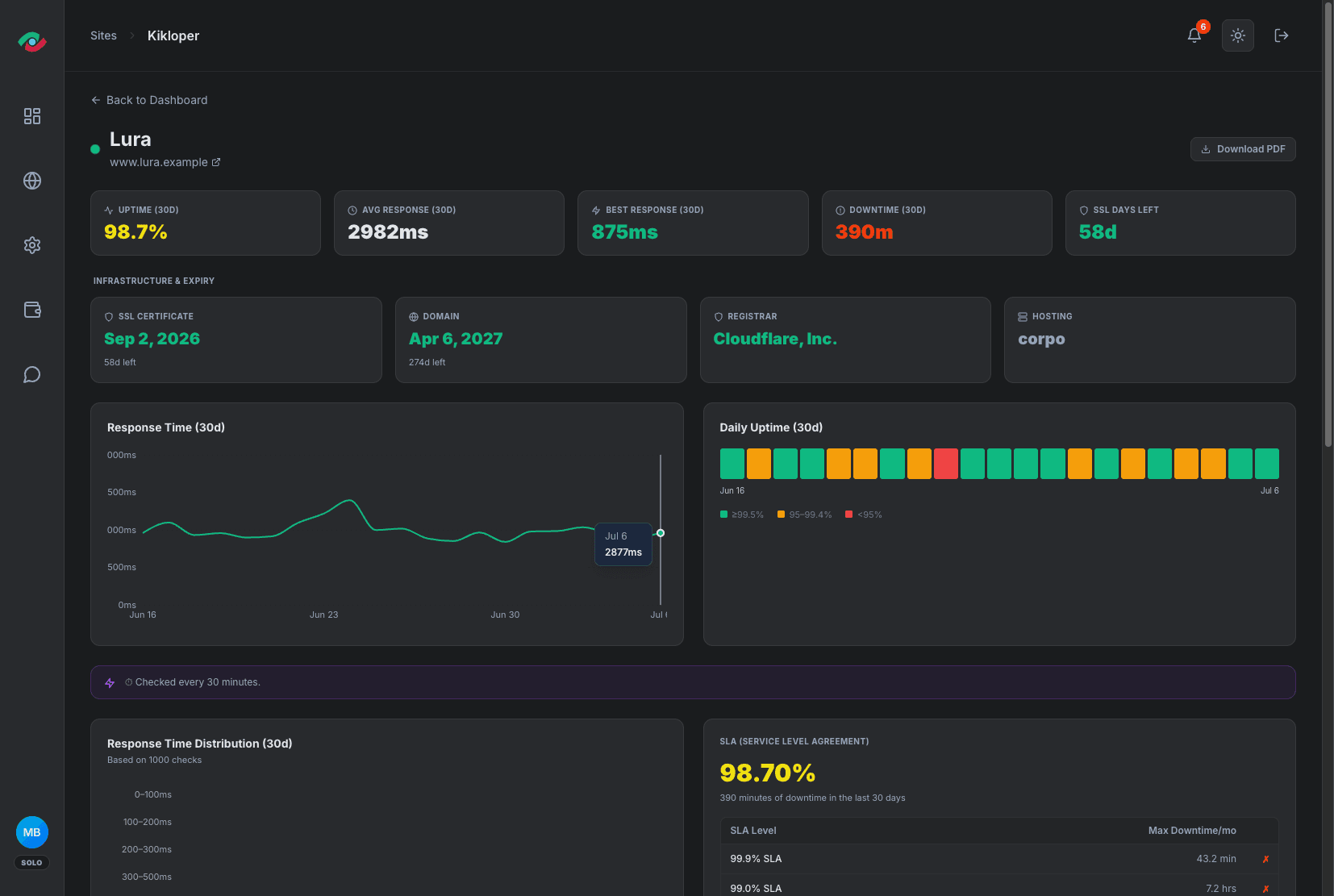
Every domain's renewal date, tracked automatically. Kikloper detects each domain's registrar and expiration date straight from the registry via RDAP, then alerts you 30, 14, and 7 days before renewal is due. One dashboard covers every client domain, so renewals become a routine you control — not a last-minute scramble.
Why It Matters
Complete site loss
An expired domain takes down more than the web server. DNS stops resolving, so the site, subdomains, and everything on that domain vanish at once. Harder to fix than a crash.
Email stops too
MX records stop resolving. Client emails bounce, and no one can reach the business during the outage.
Renewal emails fail silently
Registrar notices go to an old client address, a role inbox nobody monitors, or spam. The person responsible never sees the warning.
The portfolio problem
30 client sites means 30 renewal dates, 30 registrar accounts, 30 points of failure. A calendar reminder isn't a system.
Recovery takes days
A lapsed domain doesn't come back the moment you renew. Redemption fees ($80–200+) apply, and DNS propagation after recovery can take hours to days.
A changed nameserver can be the first sign of a hijack
Kikloper checks your domain's registration data daily and alerts you if its nameservers change or the domain enters a hold status (clientHold / serverHold) — early signals of an unauthorized transfer or a registrar problem, caught before they take the site down.
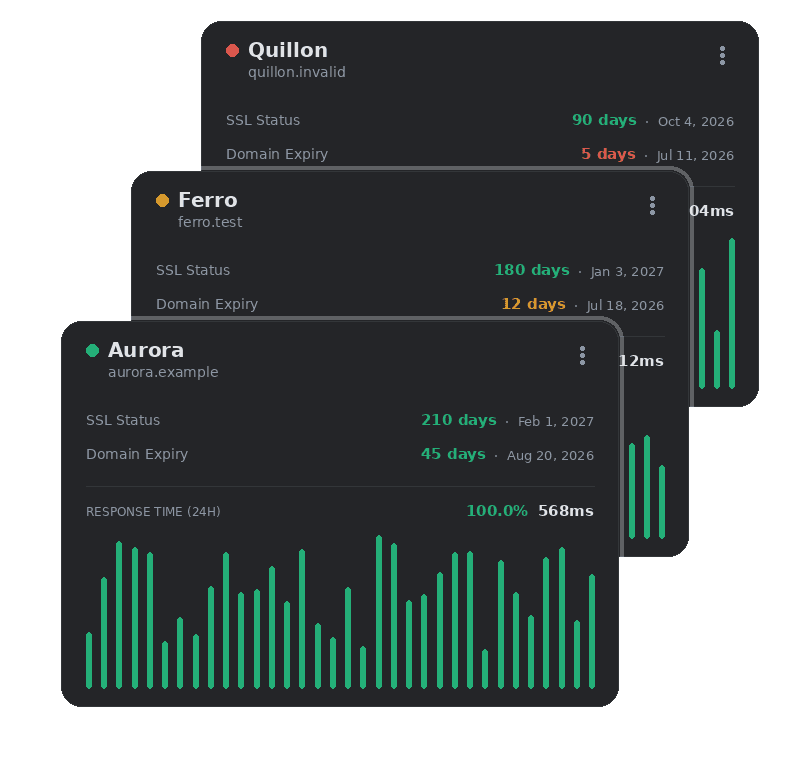
Every domain's expiry date, pulled straight from the registrar.
Kikloper automatically detects your domain’s registrar and expiration date using RDAP records. If a top-level domain isn’t supported, a fallback lookup keeps your monitoring accurate.
- checkRDAP auto registrar detection
- check30 / 14 / 7-day threshold alerts
- checkFallback lookup for unsupported TLDs
- checkOne dashboard for all sites
How it works
Add your site
Kikloper looks up the domain's registrar and expiry date automatically.
We monitor your domain
Your domain’s expiration date is checked regularly to detect changes or upcoming renewals.
You get alerted in time
Email and push notifications at 30, 14, and 7 days before expiry.
Related Features
SSL Certificate Monitoring for Every Client Site
Catch an expiring certificate before it turns a client's site into a red browser warning. Automatic checks, alerts 30, 14, and 7 days out.
Learn More arrow_forwardHosting Renewal Tracking
The one thing that can't be auto-detected.
Learn More arrow_forwardInstant Alerts, the Moment Something Breaks
Email and push notifications the second a site goes down, recovers, or a certificate is about to expire — so you act before your client notices.
Learn More arrow_forwardRelated Resources

Domain Expiration Alerts: How to Never Lose a Client’s Domain
Losing a client’s domain is a different category of problem from most website failures. A server goes down — the site is offline for hours, it gets fixed, it comes back. An SSL certificate expires — there’s a browser warning, it gets renewed, the warning disappears. These are recoverable situations. Stressful, potentially expensive in terms […]
Read Articlearrow_forward
Domain Expiration Monitoring: Why Spreadsheets Are Not Enough
A domain expiration is not like a server going down. When a server goes down, things break immediately and visibly. Alerts fire, clients call, the problem is impossible to miss. The window between failure and discovery is minutes. When a domain expires, the failure is slower and in some ways worse. The DNS stops resolving. […]
Read Articlearrow_forward
Why Hosting Renewal Reminders Aren’t Enough
Every hosting provider sends renewal reminders. Most send several — 60 days out, 30 days, 14 days, sometimes a final notice the week before expiry. The system is designed to make sure hosting renewals happen on time. And yet hosting lapses still happen. Sites still go down. Clients still call to find out why their […]
Read Articlearrow_forwardFrequently Asked Questions
You can, but only manually and one domain at a time. WHOIS output is inconsistent across registrars, often rate-limited, and gives you no alerts. Kikloper reads expiry data automatically via RDAP and warns you before renewal is due, across your whole portfolio.
RDAP is the modern, structured successor to WHOIS. It returns registration and expiry data in a consistent, machine-readable format, which makes automated monitoring reliable. Kikloper uses RDAP so tracking works the same across registrars.
The site and email stop resolving immediately, then the domain enters a grace period, a redemption period where recovery fees apply (often $80–200+), and finally pending deletion — after which anyone can register it. Recovery isn't instant: DNS can take hours to days to propagate.
Kikloper supports the vast majority of common TLDs (.com, .net, .org, country-codes, most new gTLDs) through RDAP, with fallback lookups where a registry doesn't expose expiry cleanly.
It depends on your plan — Solo covers up to 10 sites and Pro up to 20, each with domain, SSL, and uptime monitoring included. No separate charge for domain tracking. (→ pricing iç link)
Kikloper sends renewal alerts at 30, 14, and 7 days before expiry, by email — not the registrar's inbox your client set up and forgot.
Yes. Every client domain shows on a single dashboard with its renewal date and status — no logging into 30 registrar accounts.
Yes. Beyond expiry dates, Kikloper monitors your domain's nameservers and registration status daily, and alerts you if either changes unexpectedly — one of the earliest warnings of an unauthorized transfer.
Try the Full Kikloper Experience
Get full access to the Solo plan for 14 days. Monitor real websites, receive downtime alerts, track SSL certificates, and generate client-ready reports with no feature restrictions.